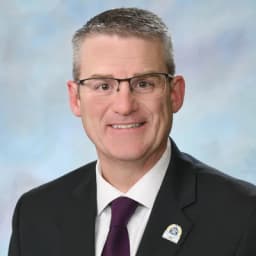
Sen. Steve Kolbeck on
Education & Schools
23 bills voted on
Votes
Changes how schools calculate property taxes and state funding for general and special education.
This bill revises property tax levies for school districts by reducing the maximum general fund levy rates and adjusting the state aid formula. It decreases the maximum levy from $5.211 to $4.874 per thousand dollars of taxable valuation for general property, from $1.125 to $1.052 for agricultural property, and from $2.518 to $2.355 for owner-occupied single-family dwellings. The bill also updates the target teacher salary base year and makes minor adjustments to the overhead rate in the state aid formula.
Adjusts funding requirements for special education programs.
This bill modifies South Dakota's special education funding by increasing the amount set aside for extraordinary expenses from $4 million to $5 million starting July 1, 2026. Beginning July 1, 2027, both the annual set-aside amount and the maximum reserve cap will increase annually by an index factor. The bill also changes the decision-making process for expenditures from oversight board recommendation and secretary approval to a process defined in section 13-37-60.
Changes how the School Finance Accountability Board makes and approves recommendations.
This bill restructures the School Finance Accountability Board's authority and processes. It changes the board from making recommendations subject to legislative committee approval to having direct authority to impose penalties, reduce state aid, require accreditation reviews, and grant waivers to school districts. The bill establishes new waiver processes for districts that exceed cash balance limits or fail to meet teacher compensation requirements, with conditions that waivers can be rescinded if districts don't maintain compliance for three years.
Makes sure kids who qualify for reduced-price school meals get them for free, with the state covering the cost.
This bill establishes that school districts cannot charge reduced-price eligible students for any meals through federal lunch and breakfast programs, allows districts to charge full-price students and employees for meals, and requires the Department of Education to reimburse districts for the costs of providing meals to reduced-price eligible students (minus federal reimbursements).
Allows schools to place disruptive students in alternative classrooms.
This bill creates new authority for school boards to assign students to alternative educational settings when those students exhibit aggressive or violent behaviors that disrupt the school or affect health and safety factors of the school or its programs. The bill includes protections ensuring it cannot limit existing enrollment options or conflict with federal disability education laws.
Redirects special donation funds to support job training programs for students.
This bill repeals the existing special donations fund for the Jobs for America's Graduates-South Dakota program and replaces it with a $500,000 appropriation from the general fund to the Department of Education. The appropriation provides grants to nonprofit organizations supporting the Jobs for America's Graduates program in schools. The bill transfers any existing money in the special donations fund to the general fund and becomes effective June 30, 2026.
Funds new manufacturing labs and classrooms at Southeast Technical College.
This bill appropriates $6,000,000 from the general fund to the South Dakota Board of Technical Education to construct an advanced manufacturing laboratory space and classrooms at Southeast Technical College. The appropriation is contingent upon the college receiving $18,000,000 from other sources (gifts, grants, donations) and no bonds being issued for the project. The bill designates administrative oversight to the Bureau of Human Resources and Administration and includes standard appropriation procedures for voucher approval and fund reversion.
Changes what school districts can spend capital funds on.
This bill reorganizes and expands the permissible uses of a school district's capital outlay fund. The bill restructures the existing law into a numbered list format and adds new permitted expenditures including: property insurance premiums, up to 15% of transportation contracts or mileage reimbursement costs, warranties on capital assets (excluding supplies), textbooks, and instructional software purchases or renewals. The bill maintains existing provisions for real property, facilities, equipment, installment payments, and capital outlay certificates.
Requires voter approval for certain school district loans and purchases.
This bill requires school districts to get voter approval before issuing capital outlay certificates. It mandates that after a public hearing, the school board must refer capital outlay certificate issuance to district voters for approval, requiring 60% affirmative vote. It also sets specific election dates and procedures for these votes.
Allows charter schools to open in South Dakota.
This bill creates a new charter school system in South Dakota. It establishes procedures for nonprofit corporations to apply to create charter schools through authorizing entities (school district boards or the Department of Education). Charter schools must maintain separate accounting/financial functions, comply with civil rights/health/safety requirements, provide education to disabled children, maintain risk management and insurance programs, and be subject to annual audits. The bill sets application requirements, approval criteria, reporting requirements, and gives priority consideration to schools serving tribal students or disadvantaged populations.
Updates background check requirements for school employees.
This bill makes minor word changes to school employee criminal background check requirements. It changes references from 'school district' to just 'school' in multiple sections, changes 'any accredited school' to 'a school' in the reporting requirements, and removes 'South Dakota' from certain references. The substantive requirements for criminal background investigations, employment restrictions, and reporting obligations remain unchanged.
Limits student cell phone use during school hours.
This bill prohibits students from using cell phones during the school day, with exceptions for approved medical/educational accommodations and health/safety emergencies. School districts must adopt policies setting disciplinary actions for noncompliance.
Changes the deadline for completing school board election recounts.
This bill revises the procedures and timeline for school board election recounts. It restructures how recount boards are appointed (giving the business manager authority to appoint board members chosen by candidates, with the secretary of state appointing additional members if there's disagreement), and adds a new requirement that any recount must be completed before the annual school board meeting held pursuant to § 13-8-10.
Defines what counts as a private school.
This bill creates a statutory definition of 'nonpublic school' in South Dakota education law. It defines nonpublic schools as institutions under non-public control that instruct compulsory school age children in mathematics and English. The bill specifies that nonpublic schools may limit enrollment, charge tuition, receive federal/state grants, and receive services from school districts, but cannot receive geographic tax revenue or state education aid. It also states that nonpublic schools may be accredited but are not required to be, and teachers at non-accredited nonpublic schools do not need state certification.
Changes the rules for petitions to challenge school tax increases.
This bill modifies school district excess tax levy procedures by: (1) requiring resolutions to specify the total maximum dollar amount of taxes over the full term; (2) changing petition requirements from 5% to 50 registered voters and extending filing deadline from 20 to 40 days; (3) requiring ballot language to state the levy duration and total maximum tax amount; and (4) requiring elections to follow special election procedures under § 13-16-6.4.
Funds an expansion to the pig barn at South Dakota State University.
This bill appropriates $1,720,000 to the Board of Regents for the design and construction of an addition to an existing swine wean-to-finish barn at South Dakota State University. The appropriation comes from other fund expenditure authority for donated moneys, and allows for cost adjustments up to 125% of the original estimate due to inflation or regulatory changes. The bill includes standard appropriation provisions for accepting additional funds, disclaiming state liability for any debt incurred, and administrative oversight.
Funds a new athletic facility at the University of South Dakota.
This bill appropriates $40,000,000 to the Board of Regents for the design and construction of an athletic facility at the University of South Dakota. The facility will include an indoor track, jumping areas, throwing cages, practice areas, locker rooms, offices, seating for 2,000 spectators, and related infrastructure. The Board may adjust costs up to 125% of the estimate for inflation and regulatory compliance, and may accept additional funding from federal sources or donations. The state disclaims any liability for debts incurred under this appropriation.
Funds construction of a new indoor sports facility at Dakota State University.
This bill appropriates $13,330,000 to the Board of Regents for the design and construction of an indoor athletics facility at Dakota State University's Beacom PREMIER Complex in Madison. The bill allows for cost adjustments up to 125% of the estimated amount due to inflation and regulatory changes, permits acceptance of external funding sources, and declares an emergency for immediate implementation.
Funds construction of a new soccer stadium at South Dakota State University.
This bill authorizes the Board of Regents to contract for the design and construction of a new soccer venue at South Dakota State University with an estimated cost of $5.04 million. The bill provides appropriation authority for donated funds, allows cost adjustments up to 125% of the original estimate for inflation and regulatory compliance, permits acceptance of federal and donated funds, specifies that no state liability is created, and establishes administrative oversight through the Bureau of Human Resources and Administration.
Updates college savings plan rules to match current federal tax law.
This bill updates the reference to the Internal Revenue Code from January 1, 2025 to January 1, 2026 for the administration of South Dakota's higher education savings plans (529 plans). This is a routine annual update to keep state law aligned with current federal tax law.
Requires voter approval when school districts want to raise property taxes.
This bill eliminates the 'opt-out' procedure for school district excess tax levies and mandates that all excess tax levies (both for general fund and capital outlay purposes) must be approved by voter election. Currently, school districts can impose excess tax levies with a two-thirds governing body vote, subject to a potential referendum if petitioned by voters. The bill removes the petition requirement and makes elections mandatory for all excess tax levies.
Increases income limits and award amounts for education scholarships.
This bill increases income eligibility thresholds for the partners in education scholarship program. It raises the initial eligibility threshold from 150% to 200% of the free/reduced lunch income standard, and increases the continuing eligibility threshold from 200% to 250% of that standard. The bill also removes a provision that allowed students to remain income-eligible for three years without re-qualification, now requiring annual re-application and income verification.
Allows schools to use nasal spray epinephrine for allergic reactions.
This bill amends South Dakota's school epinephrine administration law to allow schools to stock and administer epinephrine via nasal spray in addition to auto-injectors. The bill updates multiple sections to include 'or nasal spray' alongside existing auto-injector provisions, covering acquisition, storage policies, administration procedures, training requirements, and liability protections. The same immunity from ordinary negligence claims applies to nasal spray administration.