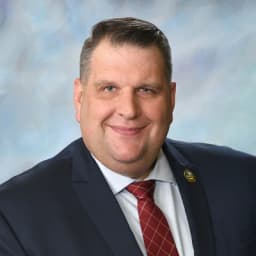
Rep. Brian Mulder on
Transportation & Infrastructure
27 bills voted on
Votes
Allows housing funds to be used for airport construction loans.
This bill transfers unobligated money from the South Dakota housing infrastructure fund to the revolving economic development and initiative fund. It authorizes the Board of Economic Development to provide zero-interest, unsecured loans up to $15 million to airport owners/operators in metropolitan areas with populations between 125,000-275,000+ for airport infrastructure projects. The loans have 20-year amortization with equal annual payments, first payment due one year after funding, and must be closed by June 30, 2030. Municipal loans are exempt from certain debt limitation chapters but subject to constitutional municipal debt limits.
Provides emergency funding for rural roads and infrastructure.
This bill appropriates $5,000,000 from the general fund to the Department of Revenue for county rural access infrastructure. The money will be deposited into rural access infrastructure funds and distributed to counties based on their proportion of small structures (like bridges and culverts) on township and county roads. The funds must be used for planning and completing inventories of these small structures as prescribed by the Department of Transportation. The appropriation will be distributed over three fiscal years (2026, 2027, 2028) with no more than one-third released each year.
Provides emergency funding for road improvements near Ellsworth Air Force Base.
This bill appropriates $8 million from the general fund to the South Dakota Ellsworth Development Authority for public roadway and related infrastructure improvements necessitated by construction activity at Ellsworth Air Force Base. The funds can be used for roadway reconstruction, rehabilitation, widening, capacity improvements, traffic safety enhancements, engineering, design, traffic studies, construction oversight, and related analysis. The authority must report annually on fund usage and is limited to 3% administrative expenses, with unused funds reverting by July 1, 2040.
Requires commercial truck drivers to speak English.
This bill requires commercial driver license holders in South Dakota to demonstrate English language proficiency as required by federal regulations. It restructures existing CDL requirements into new sections, mandates English proficiency testing (with all tests administered in English), requires law enforcement to assess English proficiency during traffic stops/accidents, and creates criminal penalties: Class 2 misdemeanor for first offense of operating a commercial vehicle without sufficient English proficiency, and Class 1 misdemeanor for subsequent offenses.
Creates a fund to manage unused rural infrastructure money for counties and townships.
This bill creates a new state-level fund called the county and township infrastructure fund to collect and redistribute unexpended moneys from county rural access infrastructure funds. Starting in 2029, counties must transfer any unexpended, unobligated rural access infrastructure moneys to this new state fund on June 30th of odd-numbered years. The Department of Revenue will administer the fund to redistribute money back to counties for rural access projects and small structure expenses.
Changes rules for out-of-state commercial driver's licenses.
This bill modifies requirements for nondomiciled commercial driver licenses by restricting eligibility to specific categories: individuals with H-2A, H-2B, or E-2 visa status, individuals from U.S. territories with those same visas, or individuals from states with decertified CDL programs. The bill adds new documentation requirements including foreign passport and I-94 forms, mandates verification through federal immigration systems, requires in-person renewals, and establishes license expiration tied to immigration status documents.
Changes drone registration fees and creates a fund to support drone programs.
This bill creates a separate registration tax structure for drones, setting rates at 1.5% for agricultural drones and 2% for other drones (lower than the current 4% and 3% rates for other aircraft). It establishes a dedicated drone aviation fund to support drone training at technical colleges, administered by the Board of Technical Education. The bill exempts small unmanned aircraft from these requirements.
Changes how the state buys highway construction services.
This bill adds a new exemption to South Dakota procurement laws, allowing political subdivisions to enter into utility contracts that will be bid in combination with Department of Transportation highway construction contracts without following standard procurement procedures. The bill renumbers existing exemptions to accommodate this addition.
Allows the state to be sued under certain federal environmental laws.
This bill authorizes the South Dakota Department of Transportation to assume federal environmental review responsibilities for highway projects under federal law. It waives the state's sovereign immunity from federal court lawsuits related to these environmental responsibilities. Most significantly, it expands the state's liability by requiring payment of attorney fees and costs to successful litigants in highway project litigation, and removes existing limitations that previously capped or restricted such payments.
Updates the official list of state highways.
This bill makes technical corrections to highway descriptions in South Dakota's state trunk highway system. It changes a reference from U.S. Highway 14B to U.S. Highway 14 in the route description through Pierre and other cities, and makes minor adjustments to geographic descriptions of highway routes in Fall River, Custer, Pennington, and Lawrence counties, including more precise boundary descriptions near Wind Cave National Park.
Creates new way to determine value of gifted used cars for tax purposes.
This bill creates an additional method for determining the purchase price of used motor vehicles acquired by gift or other transfer with no or nominal consideration. Currently, such vehicles are valued using the retail value from a nationally recognized dealers' guide. The bill adds a new option allowing the actual purchase price to be used instead, as documented by a bill of sale furnished by the secretary of revenue. The bill also makes technical corrections to cross-references in related sections dealing with motor vehicle lease taxes.
Requires snow bears to be registered and licensed like vehicles.
This bill adds 'snow bear' (defined as an enclosed, motorized, rubber-tracked vehicle with front skis used for travel over snow or ice) to South Dakota's motor vehicle titling and licensing requirements. Snow bears would need to be titled and licensed like other motor vehicles, and non-resident owners would pay an additional $100 fee for titling.
Updates rules about using phones while driving.
This bill modifies the mobile electronic device law for motor vehicle operators by reorganizing the emergency use exceptions into a clearer format with lettered subsections and adds a new exception allowing agricultural equipment operators to use handheld mobile devices while operating equipment not designed to exceed 25 mph (excluding trucks). The bill also clarifies that GPS/navigation use is allowed unless the operator is manually entering information.
Requires used car sales tax to be based on actual sale price.
This bill requires county treasurers to calculate excise tax on used vehicles sold by non-dealers based on the amount shown on a mandatory bill of sale. If no bill of sale is submitted, the tax is assessed on retail value from a dealer's guide. The bill creates a standardized process requiring sellers to provide a bill of sale to purchasers, who must submit it to the county treasurer within 45 days.
Increases the annual registration fee for electric vehicles.
This bill increases the annual registration fee for electric motor vehicles from $50 to $100. The fee is paid during annual vehicle registration and deposited into the state highway fund. The bill makes minor clarifying language changes but does not alter the definition of electric motor vehicle or change any liability standards.
Raises fees for mailing vehicle license plates and stickers.
This bill increases mailing fees for vehicle registration materials. It raises the fee for mailed decals from $1.50 to $2.50 per decal or set of decals, and increases the fee for mailed license plates from $7.50 to $12.00 per license plate or set of plates.
Waives vehicle registration fees for volunteer firefighters.
Creates a new exemption allowing active volunteer firefighters to obtain an annual exemption from motor vehicle license fees for one noncommercial automobile, pickup truck, or van. The volunteer must provide certification from their fire chief confirming active membership. The exemption does not cover excise taxes or specialty plate costs and must be renewed annually.
Allows mobile cranes to carry heavier tires on highways.
This bill increases the allowed tire weight limit for mobile cranes from 600 pounds per inch of tire width to 650 pounds per inch when the crane is moving on highways with its boom carried over the vehicle. The bill also adds a definition of 'mobile crane' as a lifting machine mounted on a self-propelled carrier with a telescoping or lattice boom designed to move between work sites.
Updates how the state adopts federal trucking regulations.
This bill updates the adoption of federal motor carrier regulations by changing the effective date from January 1, 2025 to January 1, 2026, removes the exemption for two-axle vehicles from federal regulations (meaning more small commercial vehicles will now be subject to federal motor carrier safety requirements), and removes the medical certification exemption for intrastate drivers.
Increases fines for commercial truck driver violations.
This bill increases civil penalties for commercial driver violations. It raises the maximum penalty against employers for violations of commercial driver regulations from $20,537 to $20,539. It increases penalties for drivers convicted of violating out-of-service orders from $3,961 to $3,963 for first convictions and from $7,924 to $7,926 for second or subsequent convictions. It also raises penalties against employers for other commercial driver violations from a range of $7,155-$39,615 to $7,157-$39,617.
Raises fees for reinstating licenses and getting driving records.
This bill increases reinstatement fees for suspended driver's licenses (references subsection 32-12-47.1(f) instead of the current $50 flat fee) and increases the fee for certified driving record abstracts from $5 to $7.
Creates a solid background license plate option for South Dakota.
This bill creates new solid background license plate options for South Dakota motor vehicle owners. It establishes two designs (solid black with white letters/numbers and solid white with black letters/numbers), sets fees at $100 for initial issuance and annual renewal, allows personalization for an additional $25 fee, specifies eligible vehicle types (automobiles, pickup trucks, vans, and motorcycles), and directs fee distribution between the license plate special revenue fund and state highway fund.
Adds more vehicle types to the process for titling vehicles with unpaid repair bills.
This bill expands South Dakota's unpaid repair bill titling process beyond motor vehicles to include boats, mopeds, motorcycles, off-road vehicles, snowmobiles, and trailers. It allows repair facilities to obtain title to these additional vehicle types when repairs go unpaid and owners fail to reclaim the vehicles after proper notice procedures. The bill also requires public auction sales when repair facilities cannot transfer title directly, with excess proceeds going to prior owners or the state as unclaimed property.
Makes it easier for people with controlled medical conditions to keep their driver's license.
This bill revises the standards for denying or restricting driver's licenses for individuals with medical conditions. It removes the automatic 12-month seizure-free requirement for people with convulsions, seizures, or blackouts. Instead, it requires a broader physician diagnosis of any chronic medical condition that could interfere with driving and allows temporary permits based on physician certification that the condition is adequately controlled. The Department of Public Safety can require medical examinations when they have reasonable grounds to believe an applicant's condition may affect safe operation.
Updates application process for disability parking permits and license plates.
This bill expands who can provide medical certifications for disability license plates and parking permits. Currently only physicians can provide the required certification. The bill would allow physician assistants, chiropractors, physical therapists, and certified nurse practitioners licensed under title 36 to also provide these certifications, as long as it's within their scope of practice. The bill also makes minor language changes (person to individual, shall to must, corrects spelling of dependent).
Creates a 10-year boat registration option for certain boats.
This bill creates an optional 10-year boat registration for boats that are transported exclusively on trailers registered to the same owner in South Dakota. Boat owners can elect this longer registration period instead of annual renewal, must provide proof of trailer registration and submit an affidavit about exclusive trailer transport, and pay fees only when applying or renewing the 10-year registration. If the trailer registration lapses during the 10-year period, the boat registration converts back to annual registration.
Changes speed limits for golf carts on certain roads.
This bill increases the speed limit threshold for golf cart operation on state and county highways from 25 mph to 35 mph. Golf carts will now be permitted on highways with posted speed limits of 35 mph or less, expanding where they can legally operate.