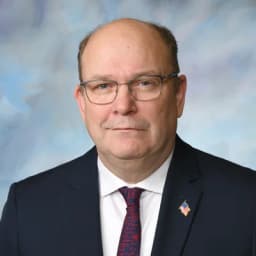
Rep. Kent Roe on
Business & Regulation
37 bills voted on
Votes
Regulates the sale of nicotine and vaping products.
This bill creates a comprehensive licensing and regulatory framework for retailers selling nicotine products in South Dakota. It requires retailers to obtain annual licenses ($1,000 fee), prohibits sales within 1,000 feet of schools, bans online sales and vending machines, establishes detailed record-keeping requirements, mandates regular inspections, and creates an escalating penalty structure ranging from $500 fines to license revocation for violations.
Allows cities and counties to issue licenses for cigar bars.
This bill authorizes counties and municipalities to issue licenses for cigar bars that allow smoking cigars on premises despite general smoking bans. Counties can approve one cigar bar license outside municipal boundaries, while municipalities can approve one license plus one additional license for every 25,000 residents. Licensed cigar bars must have a humidor, be enclosed with proper ventilation, hold certain alcohol licenses, and generate at least 10% of gross income from cigar sales. The establishments are exempt from general smoking prohibitions but can only allow cigars (ring gauge 40+) purchased on-premises.
Creates a fund to pay for capitol building repairs and renovations.
This bill appropriates $101 from the general fund to the state for the vague purpose of 'enhancing the economic health of South Dakota.' The bill includes standard appropriation language for voucher approval, warrant drawing, and fund reversion procedures, with an effective date of June 30, 2026.
Sets rules for selling nicotine products with penalties for violations.
This bill creates new regulations for vapor products (e-cigarettes) in South Dakota by: (1) restricting ingredients to only vegetable glycerin, propylene glycol, food-grade flavoring, and nicotine, with limits on toxic substances like vitamin E acetate, arsenic, cyanide, and diacetyl; (2) requiring child-resistant packaging and ingredient labeling with nicotine warnings; (3) prohibiting marketing that targets minors through cartoons, celebrities, or gaming themes; (4) restricting advertising on exteriors, billboards, and digital media; (5) banning marketing on platforms without age controls or that appeal to under-21 audiences; and (6) prohibiting free samples. Violations are Class 2 misdemeanors.
Provides emergency funding to replace the Richmond Lake dam and spillway.
This bill appropriates $101 from the general fund to the state for developing South Dakota's economic viability. The appropriation includes standard provisions for voucher approval, warrant drawing by the state auditor, reversion of unexpended funds, and becomes effective June 30, 2026.
Provides funding for economic development projects in South Dakota.
This bill appropriates $101 from the general fund to the state for economic development purposes in South Dakota. The bill includes standard appropriation language for voucher approval, warrant drawing, reversion procedures for unspent funds, and sets an effective date of June 30, 2026.
Lets work experience count toward education requirements for out-of-state cosmetology licenses.
This bill requires the South Dakota Cosmetology Commission to credit work experience toward educational hour requirements for out-of-state licensure applicants whose licenses are not equivalent to South Dakota licenses. The commission must credit two hours of work experience as one hour of education, with work experience limited to no more than half of required education hours. The bill also removes the commission's rulemaking authority over work experience credit amounts and establishes specific procedures for documentation and safety course requirements.
Protects people's genetic data privacy with civil penalties for violations.
This bill creates comprehensive privacy and security regulations for direct-to-consumer genetic testing companies operating in South Dakota. It requires companies to provide clear privacy policies, obtain express consent for data collection and sharing, implement security programs to protect genetic data, provide consumer access and deletion rights, and allow consent revocation. The Attorney General can impose civil penalties up to $5,000 per violation. The law exempts healthcare entities, educational institutions, forensic labs, and research entities operating under federal guidelines.
Changes the deadline for filing certain annual reports.
This bill changes annual report filing deadlines for limited liability companies (LLCs) and limited liability partnerships (LLPs). It creates a specific January 31st deadline for LLCs and LLPs to file their first annual report (by January 31st of the year following authorization to do business) and subsequent reports (each January 31st thereafter), while maintaining the existing general deadline for other business entities.
Prevents fraud at cryptocurrency ATMs.
This bill creates comprehensive regulation of virtual currency kiosks (cryptocurrency ATMs) by requiring operators to be licensed under existing money transmission laws. It establishes transaction limits ($1,000 daily, $10,000 monthly), caps fees at 3% per transaction, mandates fraud protection disclosures, requires full refunds to fraud victims within specific timeframes, and imposes detailed reporting requirements on operators including suspicious activity reports and complaint tracking.
Funds expansion of high-speed internet infrastructure.
This bill appropriates $87,000,000 in federal fund expenditure authority to the Governor's Office of Economic Development for providing grants to expand broadband infrastructure in South Dakota under the federal Broadband Equity, Access, and Deployment program. The bill includes standard provisions for voucher approval by the commissioner, warrant drawing by the state auditor, reversion of unexpended funds, and declares an emergency for immediate implementation.
Updates the rules for managing trusts.
This bill creates new trust provisions allowing trustees to reimburse trustors for personal income tax liability when the trustor is treated as the trust owner under federal tax law. It prohibits using life insurance cash value or loan proceeds for such reimbursements, includes liability protection for trustees making reimbursement decisions, and modifies existing trust decanting provisions with updated federal tax code references.
Requires social media companies to hand over your personal data when you ask for it.
This bill requires large social media companies (over 500,000 monthly users) to provide users with copies of their personal data in portable formats and to implement interoperability interfaces that allow users to share data between platforms and enable third-party access with user consent. It establishes data security requirements and mandates use of open protocols for data sharing between social media services.
Updates pharmacy practice regulations.
This bill modifies South Dakota pharmacy practice laws by: (1) adding a definition for 'pharmacist-in-charge' as a pharmacist designated to assume full legal responsibility for all professional and facility operations; (2) changing Board of Pharmacy rulemaking from discretionary ('may') to mandatory ('shall') for various pharmacy regulations; (3) expanding pharmacy licensing to allow non-pharmacist owners if they delegate pharmaceutical services responsibility to a pharmacist-in-charge through an affidavit; (4) allowing part-time pharmacy licenses for hospitals and nursing facilities with similar ownership and delegation requirements; and (5) authorizing the Board to create rules for remote drop sites.
Provides funding for South Dakota development projects.
This bill appropriates $101 from the general fund to the state for purposes of developing South Dakota. It includes standard appropriation language for voucher approval, warrant drawing, and reversion procedures for unused funds. The Act becomes effective June 30, 2026.
Provides funding to boost South Dakota's economy.
This bill appropriates $101 from the general fund to the state for the purpose of enhancing South Dakota's economic health. The bill includes standard appropriation procedures for voucher approval, warrant drawing, and reversion of unexpended funds, with an effective date of June 30, 2026.
Provides funding for economic development in South Dakota.
This bill appropriates $101 from the general fund to the state for the purpose of economic development prosperity of South Dakota. The bill includes standard appropriation procedures for voucher approval, warrant drawing, and reversion of unexpended funds, with an effective date of June 30, 2026.
Sets minimum damage amounts before insurance can declare a car totaled.
This bill establishes a minimum 75% damage threshold for motor vehicle total loss declarations. It prohibits insurers from declaring a vehicle a total loss unless repair costs meet or exceed 75% of the vehicle's actual cash value before damage. The bill allows exceptions when the vehicle owner provides express written authorization for total loss declaration below the 75% threshold. It also defines 'actual cash value' as current market value within 200 miles of the owner's address, considering year/make/model, accessories, deterioration, odometer reading, and accident history.
Allows hotels to use biological filters in their pools and hot tubs.
This bill creates a new permit system allowing small lodging establishments (15 or fewer sleeping rooms) to use biological filtration systems in their water recreational facilities. These systems filter water using natural processes like plants, bacteria, and microbes without continuous chemical disinfectants. The Department of Health must issue annual permits, conduct yearly inspections, and establish rules for applications, maintenance requirements, water quality testing, and fees (capped at $50). Establishments that fail inspections lose their permits and cannot reapply for one year.
Requires app stores to verify user age and get parental consent for minors.
This bill creates a new regulatory framework for mobile application stores operating in South Dakota. It adds a new violation to the state's deceptive practices law for violations of these app store requirements. The bill establishes definitions for terms like account holder, age categories (child, younger teenager, older teenager, adult), application store providers, developers, and minor accounts. It requires minor accounts to be affiliated with parent accounts and establishes age verification and parental consent requirements for app store operations.
Changes how money is distributed from the state's employer investment fund.
This bill restructures the 'Employer's Investment in South Dakota's Future Fund' by: (1) transferring administration to the Governor's Office of Economic Development, (2) defining eligible projects as research, scholarships, workforce development, infrastructure, business retention/expansion, and worker recruitment, (3) requiring business plans for business applicants, (4) limiting awards to reimbursement of actual costs with itemized invoices required for awards over $1 million, (5) requiring detailed recommendations and public posting of agreements, (6) changing reporting from biannual to annual with expanded reporting requirements to multiple legislative committees, and (7) requiring rulemaking for application processes, criteria, and performance standards.
Sets rules for selling vapes and e-cigarettes.
This bill creates a comprehensive regulatory framework for vapor products in South Dakota. It establishes mandatory licensing requirements for distributors ($100 fee) and retailers ($250 fee) of vapor products, with annual renewals. The bill sets product content restrictions (limiting ingredients to vegetable glycerin, propylene glycol, food-grade flavoring, and nicotine), requires child-resistant packaging and ingredient labeling, restricts flavored product sales to age-restricted locations deriving 25% revenue from tobacco/vapor products, mandates third-party age verification systems, prohibits public advertising of vapor products, and bans free samples. Violations are classified as Class 1 or Class 2 misdemeanors. The bill also requires record-keeping for 3 years and gives the Department of Health authority to promulgate manufacturing rules.
Protects banks that report suspected financial abuse of elderly or vulnerable adults.
This bill creates a new chapter in South Dakota law that protects financial institutions from liability when they take action to prevent financial exploitation of senior adults (65+), vulnerable adults (with impairments or guardianships), or consenting adults (who agree in writing). Financial institutions can delay or refuse transactions, prevent account changes, and notify third parties when they reasonably suspect financial exploitation. The bill provides comprehensive immunity from civil, criminal, and administrative liability for these actions, and allows institutions to extend protections beyond 30 business days if exploitation concerns continue.
Requires certain facilities to get permits from neighboring towns or counties.
This bill requires operators of high energy use facilities (buildings with 20+ megawatts of electrical power demand) to obtain conditional use permits from adjacent political subdivisions if the facility is within one mile of the boundary and the adjacent jurisdiction has zoning ordinances. This creates additional regulatory approval requirements beyond the primary jurisdiction where the facility is located.
Creates new licensing rules for estheticians, cosmetologists, and nail technicians.
This bill creates two new licensing categories for estheticians (basic and advanced) and restructures the cosmetology licensing chapter. It establishes specific scope of practice for basic estheticians (limited to hands-on cleansing, exfoliating, stimulating, applying topical treatments, extracting comedones/impactions, and eyebrow/eyelash services) and advanced estheticians (includes additional procedures like chemical exfoliation, dermaplaning, microdermabrasion, and electrical energy treatments). The bill also updates definitions and scope of practice for cosmetologists and nail technicians, and adds restrictions prohibiting treatment of medical disorders or practices that penetrate beyond the stratum corneum.
Allows school booster clubs to run bingo games and raffles for fundraising.
This bill expands the list of organizations authorized to conduct bingo games, lotteries, and use pull-tab devices by adding 'booster clubs' to the existing categories. It reformats the existing law from a paragraph structure to a numbered list format, and clarifies that mechanical pull-tab dispensing devices can be used at establishments not owned by the authorized organization as long as the proceeds go to the authorized organization.
Makes non-compete agreements enforceable for jointly owned businesses.
This bill creates a new law allowing business entities to include non-compete agreements in their governing documents or ownership transfer contracts. The non-compete provisions can prevent former owners from engaging in the same or similar business within the entity's geographic area for up to three years after transferring their ownership interest.
Updates the definition of e-cigarettes and vaping devices.
This bill modifies the definition of 'electronic smoking device' in South Dakota Code 34-46-1 by clarifying that the device must contain or deliver nicotine specifically, and makes minor grammatical changes to the definition language.
Updates rules for notifying utilities before digging.
This bill revises the timing calculations for one-call notification requirements for excavation projects. It clarifies that the 48-hour notice period begins at 12:01 a.m. the day after notice is submitted (excluding weekends and holidays), and establishes that operators must mark underground facilities within either 48 hours of receiving notice or by the excavation start time, whichever is later. The bill also makes minor formatting changes to existing language about clearance requirements and hand digging near marked facilities.
Changes rules for who can serve on farm insurance company boards.
This bill modifies farm mutual insurer regulations in two ways: (1) increases the maximum number of directors on a farm mutual insurer's board from eleven to fifteen, and (2) expands director eligibility to allow individuals who are members of the insurer's affiliates to serve as directors, not just direct members of the insurer itself. The bill also defines 'affiliate' as any entity that directly or indirectly controls, is controlled by, or is under common control with the insurer.
Updates or removes laws about the state athletic commission.
This bill comprehensively revises South Dakota's athletic commission law by adding detailed definitions for boxing, kickboxing, and mixed martial arts terms; expanding the commission's regulatory authority over competitions and sparring exhibitions; requiring licenses/registrations for all participants including fighters, managers, promoters, officials, and seconds; establishing fee structures up to 5% of gross revenues with minimum fees up to $5,000; and creating procedures for disciplinary actions, complaint investigations, and bout result verification.
Creates a simpler way to form certain business partnerships.
This bill creates two pathways for forming limited liability limited partnerships (LLLPs) in South Dakota: (1) allows existing limited partnerships to qualify as LLLPs by obtaining partner approval, filing a statement of qualification, and adding proper name designations, and (2) creates a new direct formation process by filing a certificate of limited liability limited partnership with the secretary of state that includes the entity name, office addresses, registered agent information if no SD office, an election statement, and optional deferred effective date.
Requires licenses for online betting on horse and dog races.
This bill regulates online pari-mutuel wagering (betting) on horse and dog races by requiring only licensed multi-jurisdictional totalizator hubs to operate online betting platforms in South Dakota. It establishes tax obligations for both in-state and out-of-state operators, with out-of-state operators taxed based on contributions from South Dakota residents. The bill also updates federal law references and makes minor grammatical changes to existing racing statutes.
Updates rules for addiction counselors and prevention services.
This bill revises South Dakota's addiction counseling and prevention services regulation by expanding practitioner definitions to include new categories (addiction counselor supervisees, prevention specialist supervisees, peer support specialists and their trainees/supervisees), reorganizing board duties to focus on competency and public safety, establishing new rulemaking authority for education/examination/practice standards, setting specific fees for various certifications and renewals, expanding title protection to cover all new practitioner categories, allowing reciprocity for out-of-state licensed practitioners, and strengthening regulatory oversight of addiction treatment professionals.
Changes licensing requirements for public accountants.
This bill modifies provisions related to public accountant licensure by updating terminology and definitions in the accountancy laws. It makes technical changes to definitions including changing 'may' to 'shall' for the board's rule-making authority, updates language around certificates and permits, removes references to 'substantial equivalency,' and makes various grammatical and structural changes to the South Dakota Board of Accountancy statute.
Encourages businesses to accept cash payments.
This concurrent resolution encourages South Dakota citizens to use physical cash in transactions whenever possible and to support businesses that offer cash discounts. It also encourages businesses to offer discounts for cash payments. The resolution cites benefits including privacy protection, reduced transaction fees for businesses, keeping money in-state, inclusion of unbanked populations, and disaster resilience.
Requires background checks for social workers who want to practice in multiple states.
This bill establishes criminal background check requirements for social workers seeking multistate licenses under the social work licensure compact. It requires applicants to submit fingerprints for state and federal background checks, pay associated fees, and allows the board to consider criminal history information when determining whether to issue a multistate license. The board cannot issue a multistate license before receiving the background check results.